Salvage Art Institute reimagines confronts and articulates the condition of the role of no-longer-art-material claimed as "total loss," resulting from art damaged beyond repair,
removed from art market circulation due to its total loss of value in the marketplace yet stored in art-insurance claim inventory.
Having renounced the perpetual art market cycle of valuation and exchange, SAI seeks to use No Longer Art
to propel us towards a dramatic social transformation grounded in "moral revival".
SAI NEWS:
Chapter 12: SAI 0009 from No Longer Art: In a Coma - Broken Cindy - poem by Eileen Myles, published by Girls and Queers to the Front, as English-Polish bilingual zine
Chapter 7: SAI 0044 from No Longer Art: In a Coma published in Documents of Contemporary Art "Speculation" edited by Marina Vishmidt
Chapter 4: SAI 0025 from No Longer Art: In a Coma published in the 2023 issue of Spiral magazine by The Rubin Museum of Art
Salvage Art Institute spoke at the Harry der Boghosian Fellowship Online Symposium: Debris, Constellations, and Counter-Histories at the Syracuse University School of Architecture on April 8, 2022.
Salvage Art Institute continues to host No Longer Art But...
discussions to encourage the reimagining of value systems interrupted by the global crisis. Please contact us for schedule.
No Longer Art: Salvage Art Institute exhibition has closed on March 24, 2019 at Museo de Arte de Zapopan, Mexico.
Salvage Art Institute is accepting proposals for SAI: Radical Access Stewardship Program. Details coming soon. Contact us for more information.
Salvage Art Institute is working on SAI Anthology, a collection of essays that consider the phantom world of artworks officially deemed of no commercial value.
Contributors will include Julia Pelta Feldman (conservation scholar), Eileen Myles (poet and writer), Pamela Smith (science historian),
and Jeffrey Weiss (curator), among others.
No Longer Art: Salvage Art Institute, at the Neubauer Collegium for Culture and Society, University of Chicago, has closed.
SAI PRESS / IMAGES:
Selected writings/press about Salvage Art Institute
Selected exhibition documentation and individual salvaged artwork images from Salvage Art Institute
SAI POLICIES:
1. SAI is a global haven for all art officially declared as total loss, removed from art market circulation
and liberated from the obligation of perpetual valuation and exchangeability. (We only provide haven from market valuation. Our inventory
is not isolated in a timeless chamber but is instead able to interact with and find equilibrium with its environment and be redefined through its introduction into new social relationships--think composting, not recycling).
2. SAI claims stewardship over all total loss
inventories as they are declared, wherever and whenever, with or without
physical transfer. (Special emphasis is placed on the building of our inventory through declaration, as performed and virtual networks
assume equal weight with the physical.)
3. SAI considers the formal declaration of total
loss an act of transformation and subsequently refers to the transformed
property as "No Longer Art." "No Longer Art But...".
4. SAI seeks to maintain the zero-value of "No Longer Art"
"No Longer Art But..." and recognizes its right to remain independent and divorced from the
demands of future marketability. Against mere financial speculation, we hope to use this inventory to map out a new
future grounded in moral revival.
5. SAI aspires to make the "No Longer Art"
"No Longer Art But..." inventory accessible to public view examination and use.
SAI provides an autonomous yet accessible
space for "No Longer Art But..." to reveal its qualities and transformative capacities
via interdisciplinary debate.
6. SAI approaches the "No Longer Art"
"No Longer Art But..." inventory through
a non-hierarchical system and aims at democratic principles. Each item of SAI
inventory can potentially deliver has equally valid revelations
and unique affordances.
7. SAI conceives the declaration that an object is
"No Longer Art"
"No Longer Art But..." as the symmetrical inversion of the subjective declaration that
any object may be art. The signature of the adjuster meets and cancels the
signature of the artist. (Reversal of artist's signature)
8. SAI eschews the aesthetics and sensationalism
of damage. Rather, it is devoted to examining the structural implications of
total loss across art's conceptual, material, legal, actuarial and financial
identities. (SAI imagines what new relationships may be forged in the wake of these different losses.)
9. SAI is centered on new understandings of the tactile objecthood of
"No Longer Art"
"No Longer Art But...", on its obdurate survival, and on its transformed physicality.
SAI confronts viewers with the material signs of alteration and the legible
traces of each piece's history. (The Covid-19 pandemic makes us hyper-aware of our touch. This new sensitivity offers us the potential to think again about our material traces in the world, about what objects can do to us, about what we can do to them and to each other.)
10. SAI treats crisis as an opportunity to articulate new approaches to value and culture. "No Longer Art But..." objects will be considered a unique point of departure from which to chart a more equitable future.
- Edited March 2020 and March 2022 by EK and MW.
SAI TIMELINE:
April 8, 2022: SAI at the Harry der Boghosian Fellowship Online Symposium: Debris, Constellations, and Counter-Histories at the Syracuse University School of Architecture.
May 26, 2020: SAI walks SAI 0015 from the East Village to the New York Stock Exchange, confronting the latter with a zero-value object as it re-opens for in-person trading for the first time since its covid-induced shutdown.
April 25, 2020: SAI online discussion on how the inventory--reimagined as "No Longer Art, But..."--can bring forward new forms of value in the face of global crisis.
Sept 30, 2019: SAI recovers No Longer Art inventory from GSAPP Columbia University storage. Two sections: SAI NLA Downtown and SAI NLA Upstate regain continuous access
March 18, 2019: SAI interviews Patricia Okomou for the position of Site Coordinator and Community Liaison for Salvage Art Institute's Radical Access Stewardship Program ahead of her trial.
Nov. 29, 2018 - March 24, 2019: No Longer Art: Salvage Art Institute exhibition at Museo de Arte de Zapopan, Mexico.
Nov 11, 2017 - Feb 25, 2018: No Longer Art: Salvage Art Institute exhibition at BNKR in Munich, Germany.
November 11, 2017: Opening talk for No Longer Art: Salvage Art Institute at BNKR in Munich, with introduction, in German, by Ludwig Engel, followed by Elka Krajewska and Mark Wasiuta.
October 1, 2017: Auction record for loaned SAI0048L found at artnet auctions. It includes a Sept 5, 1980 letter from the artist explaining and authorizing scratches and marks on the surface of the print. SAI submits the letter as place-holder for the previously exhibited print for the BNKR exhibition.
August 11, 2016: Case study for John Sunyer's Financial Times article, "Do as Told or Suffer",
is no longer in AXA Art's ownership. SAI enters it into research database as SAI 0054P (public research).
February 19 - May 1, 2016: Salvage Art Institute participated in Making Use: Life in Post-Artistic Times
at the Museum of Modern Art in Warsaw, Poland.
November 5, 2015:
No Longer Art: A Narrative published by McNally Jackson Books.
July 22, 2015: community meeting
for SAI Untitled Intelligent Lot project in Woodlawn, Chicago.
June 20, 2015: SAI in conversation with writer Amelia Groom as part of the public program for the Sandberg Critical Studies MFA, Critical Studies room at Burgerweeshuis, IJsbaanpad 1-5, Amsterdam.
June 5, 2015: Salvage Symposium: Salvage Art 2.1 at the Neubauer Collegium for Culture and Society, University of Chicago, followed by SAI Untitled Intelligent Lot site tour and community meeting at the Little Black Pearl Art and Design Center.
April 24, 2015: Salvage Symposium: Salvage Art 2.0 at the Reva and David Logan Center for the Arts, University of Chicago, on occasion of SAI's No Longer Art exhibition.
April 23, 2015: No Longer Art exhibition opens at the Neubauer Collegium for Culture and Society at the University of Chicago.
April 22 - May 3, 2015: An Exhibition to Benefit Dancing Foxes Press, organized by Bridget Donahue and Jacob King, at Bridget Donahue Art Gallery, New York.
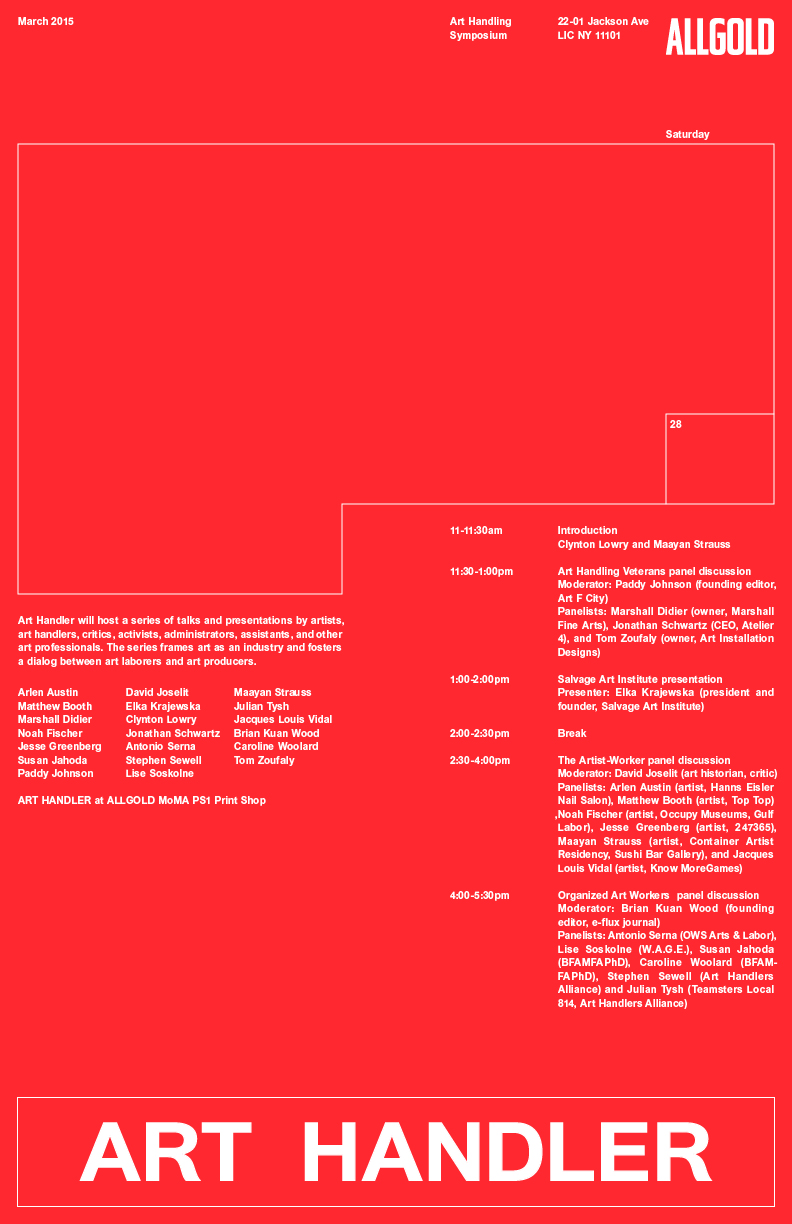
March 28, 2015: SAI talk at Art Handler symposium, All Gold (MoMA PS1 Print Shop).
February 18, 2015: Speculation, Now book launch, published by the Vera List Center for Art and Politics, New School, EK/SAI glossary entry for
insurance.
December 24, 2014 : SAI Reference Shelf, by Matthew Wagstaffe, goes up at McNally Jackson Books, New York.
December 8, 2014 : SAI walk-through at SAI Untitled Lot.
November 20, 2014: The Life and Death of Works of Art: Discussion Panel, curated by Christophe Lemaitre, at Chez Treize, Paris, France.
November 12, 2014: WNYC's Radiolab recording session with SAI (air date to be announced).
November 8, 2014 - March 29, 2015: The Life and Death of Works of Art, curated by Christophe Lemaitre, at CNEAI, CHATOU, France.
September 2, 2014: Ben Lerner's novel 10:04 comes out from Faber & Faber. The "Institute for Totaled Art" is modeled on SAI.
August 24, 2014: SAI expands its inventory with AXA Art France: SAI 0053.
July 24, 2014: SAI is consulted by graduate student at Bard College's Center for Curatorial Studies.
May 22, 2014: Salvage Art Institute is invited by Christophe Lemaitre for the upcoming show The Life and Death of Works of Art, at CNEAI, Paris, France.
May 15, 2014: Salvage Art Institute participates in Salvage: A Conference/Conversation/Caucus on Behalf of the Act and the Art of Salvage at the Cochrane-Woods Art Center, University of Chicago.
February 19, 2014: First production meeting with Dancing Foxes Press.
October, 2013: Received a new case study work from AXA Art Corp, SAI 0050.
October 18, 2013: SAI visits Art Historian Christine Mehring at the University of Chicago to discuss collaboration: SAI Untitled based on a dismantled public art sculpture. For more information visit Material Matters: Project 2: SAI Untitled at the Neubaeur Collegium
May 30 -
June 22, 2013 Maintenance
Required: curated by Curatorial Fellows of the Whitney Museum Independent
Study Program, The Kitchen, NYC
March 3, 2013: No Longer
Art at the Arthur Ross Architecture Gallery closed.
February, 2013: Martha Buskirk addresses SAI in her talk "Negotiating the Ineffable", presented at CAA 101st Annual Conference, New York
February 18, 2013: SAI inventory
returns to the Arthur Ross Architecture Gallery, accessible by appointment.
December 20, 2012: No
Longer Art goes to recess
November
30, 2012: Roundtable Discussion with Art Historian Alexander Dumbadze, Poet,
Novelist and Critic Ben Lerner, Architectural Historian Andrew Herscher, Artist
Elka Krajewska, Artist and Art Lawyer Sergio Muñoz Sarmiento, Architecture
Theorist Felicity Scott, Anthropologist Michael Taussig, Certified Appraiser
and Valuation Specialist Renee Vara, Director Of Exhibitions Mark Wasiuta.
Arthur Ross Architecture Gallery, Buell Hall, Columbia University. 2:00 - 6:00
PM
November 14, 2012: SAI and GSAPP open No
Longer Art
exhibition at Columbia University, Arthur Ross Gallery, with a conversation with
political theorist Jane Bennett, President and CEO of AXA Art Insurance
Corporation Christiane Fischer, artist Elka Krajewska, conservator Christian
Scheidemann, Director of Exhibitions Mark Wasiuta, and GSAPP Dean Mark Wigley, 6:30pm.
November, 2012: AXA Art gifts "total loss" objects to support Salvage Art Institute exhibition and public program at Columbia University
July 10, 2012: SAI inventory moves to Morgan
Manhattan Storage
April 13, 2012: SAI signs the Deed of Gift of
AXA Art�s total loss inventory
July 27, 2011: AXA Art's Matthew Knight presents
at GSAPP studio
July/August 2011: Second studio focused on SAI
at GSAPP, Columbia University
March 2011: Copyright of No Longer Art preface
March 30, 2011: Visit to AXA Art Storage in
Brooklyn, NY
November 4, 2010: AXA Art confirms their
participation in SAI program
October 13, 2010: Request to visit to AXA Art
storage
July 23, 2010: AXA Art's President/CEO
Christiane Fischer's visit to Columbia GSAPP studio (with Fine Art Specialist
Matthew Knight)
June/August 2010: First studio focused on SAI at
GSAPP
June 18, 2010: GSAPP studio trip to Staten Island,
inspection of 7 Bank Street lot
May 25, 2010: Salvage Art Institute, (DBA),
registered in the State of New York, Richmond County
April 7, 2010: Meeting at AXA Art with the
President/CEO, Director of Claims, Fine art specialist and Head of Global
Public Relations
February 9, 2010: Meeting with Mark Wasiuta
discussing SAI and GSAPP collaboration
February 8, 2010:
Submission of application for Rockefeller cultural foundation grant. Proposes
Salvage Art Institute on the shores of Staten Island as the first public
salvage art research space
January 29, 2010: first presentation of SAI at
AXA Art's office - meeting with Matthew Knight
January 11, 2010: First official contact with
AXA Art via Rosalind Joseph. Same day, Matthew Knight responds "Your endeavor is of interest to
us."
November 25, 2009: Studio meeting with Felicity
Scott, GSAPP Columbia University, who proposes the project to the Dean of
GSAPP. The museum concept transforms into the concept of an institute.
July 2009: First draft of Salvage Art Museum
mission statement
May 16, 2009: The idea of Salvage Art Museum
conceived at a meeting
with Rosalind Joseph, Head of Global Public Relations, AXA Art
SHORT HISTORY BY ELKA KRAJEWSKA - SAI PRESIDENT AND FOUNDER
In
May 2009 I spent an afternoon with my neighbor, Roz, a PR person for AXA Art,
the only globally operating specialty art insurance company. I was told about
AXA warehouses that store "Salvage Art", the industry name for
no-longer-artworks that become AXA's property after the company paid out full
market value on a claim in a total loss case. There is a sea of them behind
walls.
Since
that conversation, I have not been able to think of much more than all that
non-art, art?, dead-art or what?.. and have become absorbed in trying to
articulate my thoughts around these cadavers, the material that lives in limbo,
in secret, as invisible, petrified "art-no-longer" that is
scrupulously databased and stored all around the country, all over the world
perhaps.
The
condition that interests me begins when an artwork is declared a "total
loss" and ends when it resurfaces in the art market in some form. A pure
and radical realm of the un-explored, with implications in many different
realms and disciplines I feel I am just beginning to uncover.
At
the start of 2010 I applied for a Rockefeller grant (Idea ID 1491) as Salvage
Art Institute (SAI), proposing to focus on "art material" removed
from art market circulation due to accidental damage. I approached AXA Art with
a proposal for intellectual cooperation and was promised access to their
storage. In May the Salvage Art Institute was registered with a State of New
York, Richmond County Clerk and later was invited to Columbia University's
Graduate School of Architecture, Planning and Preservation to focus a graduate
studio course Damage Control on SAI's possible "home". (Summer 2010,
Summer 2011)
What I imagine for the future is not
simply one more gallery show, but rather the development of an arena of
discussion centered on the subject of "total loss art" condition
exhaling behind warehouse walls, shut off from the world of commerce and
consciousness.
Together with a board of SAI advisors I
am devoted to developing discussion and conversation, new themes related to this
phantom art world, engaging the most interesting minds from a variety of
disciplines, and I see Columbia's support as just the beginning.